
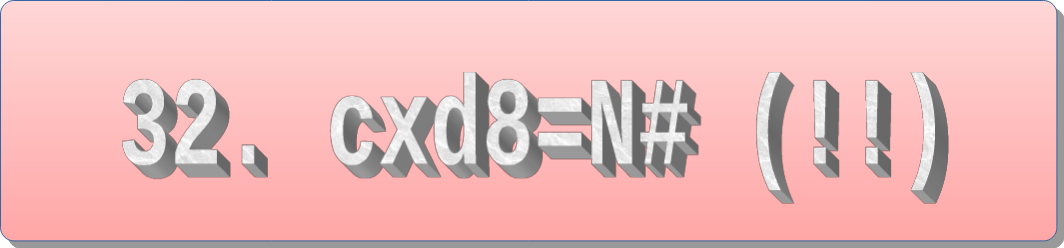
Do you know what this means? Skip to the end for an answer…
Algebraic Notation…
…is the standard and internationally recognized method for recording chess moves, endorsed by FIDE, the global chess governing body. It uses a coordinate system where each square on the board is identified by a letter (a–h for files) and a number (1–8 for ranks). For example, the square in the bottom-left corner from White’s perspective is a1 (see below).
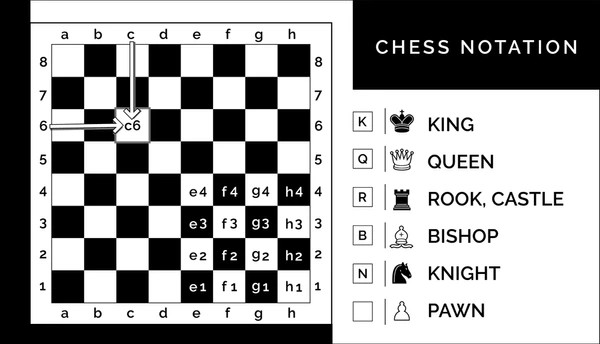
Piece Abbreviations
- K = King
- Q = Queen
- R = Rook
- B = Bishop
- N = Knight (used instead of K to avoid confusion with King)
- P = Pawn (usually omitted in notation, as pawns are implied by their move)
Move Examples
- e4 = Pawn moves to e4
- Nf3 = Knight moves to f3
- Bxc6 = Bishop captures on c6
- O-O = Kingside castling
- O-O-O = Queenside castling
- d8=Q = Pawn promotes to Queen on d8
Special Symbols
- + = Check
- # = Checkmate
- e.p. = En passant capture
- ! = Good move (in annotations)
- ? = Bad move (in annotations)
Other Notation Standards
- Descriptive notation, once common in English- and Spanish-language publications, is now largely obsolete.
- ICCF numeric notation is used in international correspondence chess, replacing letters with numbers.
- Portable Game Notation (PGN) is a widely used text format based on algebraic notation for storing and sharing games in software.
- For learning and practice, figurine algebraic notation (using ♘, ♗, etc.) is preferred in international chess literature to transcend language barriers.
Solution
Click to open for the breakdown…
32. cxd8=N# (!!)
| Element | Translation |
|---|---|
| 32. | 32nd Move |
| cxD8 | The c file pawn takes whatever piece is on D8 |
| =N | The pawn promotes to a Knight |
| # | The Knight checkmates the King |
| (!!) | Brilliant move (underpromoting to score the win) |