
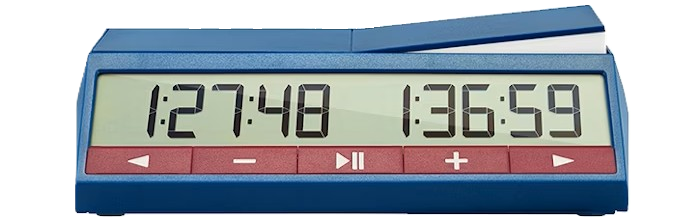
“Does anybody really know what time it is? Does anybody really care?”
Overview
The lines at the top of the page come from the first song recorded by the band “Chicago” for their debut album in 1969. While we can’t speak for the rest of the world, but when it comes to chess, the answer is a resounding “Yes!”. From the first sand hourglass used at a London tournament in 1860 to the modern digital clocks, chess tournaments world wide have used time controls. At first, it was just to keep matches from lasting an excessive number of hours (or days!). As technology changed and improved, so did the number of time controls “standards” that are used, especially for FIDE or USCF rated tournaments. That allows tournaments to attract and cater to different player types and skills, which is good for the sport.
Prescott Chess Club’s Approach
As a USCF affiliate, the Prescott Chess Club follows the USCF time control standards listed below… duh!… for our formal events (tournaments)! For our casual meet ups, it is more like the Wild, Wild West; it can be whatever time controls the players agree on for each individual game, or for mini-events, whatever the Director chooses that day depending on the people attending.
USCF Standards Summary
USCF Time Controls are categorized based on total playing time per player, including any delay or increment. The system has three categories that a player may be rated in:
Categories
- Blitz: Games with 5 to 10 minutes per player (inclusive), such as G/5 or G/10. These are rated under the Blitz rating system.
- Note: G/5 is not rated by USCF, but G/5 with a delay or increment may be allowed if properly announced.
- Note: G/5 is not rated by USCF, but G/5 with a delay or increment may be allowed if properly announced.
- Quick Chess: Games with 10 to 65 minutes per player (inclusive). This includes time controls like G/30, G/60, or 40/90 SD/30. These games affect the Quick rating.
- Regular (Slow) Chess: Games with more than 65 minutes per player. This includes controls like 40/120 SD/60 or G/90. These affect the Regular rating.
Dual-Rated Games
- Time controls between 30 and 65 minutes (inclusive) are dual-rated, meaning they affect both the Quick and Regular ratings. For example, a 60-minute game with a 5-second delay (total 65 minutes) is dual-rated.
Key Rules
- Delay/Increment: Each second of delay or increment adds one minute to the total playing time for rating purposes. For example, G/60 d/5 is considered a 65-minute game.
- Sudden Death (SD): Common for primary or secondary controls. Games must be completed within the time limit.
- Multiple Time Controls: Common formats include 40/90 SD/30 (40 moves in 90 minutes, then 30 minutes sudden death) or 40/100, SD/30 d10.
- Half-K Option: Organizers may designate events as “half-K” to reduce rating point changes by 50%, especially useful for faster controls.
- Digital Clocks: USCF recommends 5-second delay for regular events and 3-second delay for quick events. Non-standard delays require advance announcement.
Other Items of Note
- USCF does not rate games with time controls under 5 minutes (e.g., bullet).
- FIDE-rated events have stricter requirements, including minimum time controls and session limits.
FIDE Standards Summary
Although not used by the Prescott Chess Club, it doesn’t hurt to see what they are in case you ever want to play a FIDE event:
Blitz Chess
- 3 minutes per player with a 2-second increment per move, used in official FIDE events.
Rapid Chess
- A somewhat slower 15 minutes per player with a 10-second increment per move.
Classic Chess
- The most common classical time control for FIDE-rated events is 90 minutes for the first 40 moves, followed by 30 minutes for the remainder of the game, with a 30-second increment per move starting from move 1. This format ensures sufficient time for deep strategic planning while maintaining tournament efficiency.
Special Events
- At the highest levels, such as the World Chess Championship or Candidates Tournament, more complex controls apply: 120 minutes for the first 40 moves, 60 minutes for the next 20 moves, and 15 minutes for the rest of the game, with a 30-second increment from move 61.
Other Items of Note
- FIDE also recognizes sudden death, increment (Fischer), and byo-yomi formats, with rules defined in the FIDE Handbook (Section C.07: Time Control). These controls ensure consistency across global tournaments and support title norms and rating purposes.